After nearly a decade of explosive battles, profound friendships, and a relentless quest to redefine what it means to be a hero, My Hero Academia has finally crossed the finish line. Season 8, billed as the “Final Season,” culminated today with Episode 11—“Boku no Hīrō Akademia”—airing simultaneously in Japan and streaming globally on Crunchyroll at 5:30 AM EST. Clocking in at just 11 episodes, this truncated run adapted the harrowing climax of the Final War Arc and the tender Epilogue Arc from Kōhei Horikoshi’s manga, wrapping up Izuku Midoriya’s journey in a way that’s equal parts gut-wrenching and uplifting. If you’ve been riding this emotional rollercoaster since 2016, prepare to ugly-cry: this finale doesn’t just end a series; it launches a legacy into the stars.
A World Rebuilt from the Ashes: The Post-War Reflections
The episode opens in the fragile calm after the storm, picking up threads from the previous installments where heroes and villains alike lay broken but unbroken in spirit. We see glimpses of a society clawing its way back from devastation—the scars of All For One and Tomura Shigaraki’s rampage still fresh, but hope flickering like embers in One For All itself. Hawks, now a pivotal figure in the reformed Hero Public Safety Commission, extends a pardon to Lady Nagant, the sharp-shooting vigilante whose tragic arc once mirrored the series’ darkest themes of corruption. True to her complex character, Nagant declines full reintegration, opting instead to watch from the sidelines as a quiet observer of this evolving hero world. 11
Meanwhile, Gentle Criminal—ever the theatrical softie—steps into freedom, his quirk of elasticity now a tool for genuine good rather than viral stunts. It’s a small but poignant beat, underscoring the manga’s core thesis: even the most wayward souls can find redemption in a society willing to extend a hand. But the emotional core lies with Deku (Izuku Midoriya), who makes a solemn pilgrimage to Spinner’s bedside. Carrying the weight of Shigaraki’s final, fractured words, Deku passes them on, bridging the chasm between hero and villain one last time. Spinner, the last remnant of the League of Villains, vows to immortalize their story—not as glorification, but as a cautionary tale in a forthcoming book. It’s a raw, unflinching look at legacy, forcing viewers to confront the humanity in those the world labeled monsters.
These vignettes aren’t mere epilogue filler; they’re the connective tissue of a narrative that’s always prioritized people over powers. As Class 2-A (formerly 1-A) reconvenes at U.A. High, now bustling with wide-eyed first-years, the excitement is palpable. New students gush over pro heroes like Katsuki Bakugo and Shoto Todoroki, a meta nod to how these once-awkward teens have become icons. Uraraka and Froppy share a quiet moment of solidarity, their bond forged in the fires of loss—echoing Ochako’s heartbreaking breakdown over Himiko Toga in prior episodes—while Red Riot and Mina Ashido team up for a demo that blends brute force with acidic flair. Even Toru Hagakure and the ever-invisible Twinkles (a fresh face from the support course) shine in tandem, their teamwork a reminder that quirks are strongest when shared.
Significant Moments That Will Haunt (and Heal) You
Episode 11 thrives on these intimate beats, but it’s the time skip—vaulting us eight years into a brighter future—that cements its status as a masterclass in closure. Eri, the once-traumatized girl whose horned quirk symbolized the series’ exploration of abuse and recovery, appears all grown up, her smile radiant and unscarred. It’s a tear-jerker payoff to her arc, proving that healing isn’t linear but possible.
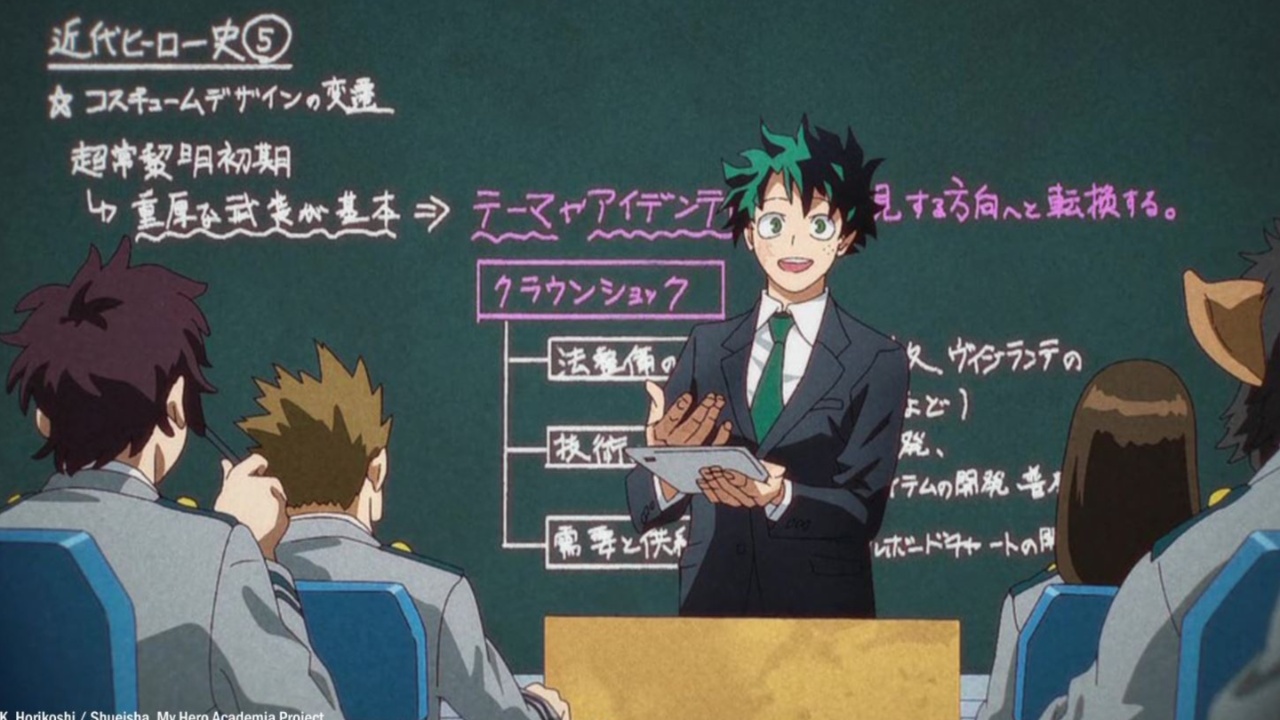
Then comes the heart-stopper: Deku as a teacher at U.A. No longer the inheritor of All Might’s mantle in the traditional sense—his arms mangled from the war, One For All reduced to faint embers—Deku has pivoted to nurturing the next generation. His desk overflows with photos of students, including a now-teenage Kota (the water-quirk kid from the Training Camp arc) and that mysterious boy who emerged from an abandoned home at the war’s end. Aizawa, ever the stern mentor, ribs him about being too lenient, but the kids’ adoration is evident. Deku’s muttering habit lives on, now channeled into lesson plans, fulfilling the “Fuwa” inspiration from earlier seasons to pass the torch through education.
The episode’s emotional apex unfolds at the All Might statue, now reimagined not as a solitary savior but surrounded by civilians—a subtle evolution of hero society from idol worship to communal strength. Here, Deku encounters Dai, a quirkless kid echoing his own childhood dreams. With gentle resolve, Deku tells him, “You can be a hero too,” mirroring All Might’s life-altering words to young Izuku. It’s a full-circle moment that had fans worldwide reaching for tissues, blending nostalgia with forward momentum.
But My Hero Academia wouldn’t be itself without a fake-out twist. As Deku walks away, seemingly alone in his civilian life, All Might materializes like a ghost from the past—skinny, smiling, and utterly iconic. Deku’s fanboy squeal is pure joy, a callback to Season 1’s wide-eyed wonder. All Might’s gift? A state-of-the-art hero suit, engineered by Melissa Shield and Mei Hatsume, bankrolled by a Class 1-A crowdfunding effort. “You earned this power too,” All Might echoes from their first meeting, validating Deku’s scars as badges of growth. 8 It’s the ultimate “Plus Ultra” affirmation: heroism isn’t about quirks; it’s about heart.
Animation That Soars to New Heights
Studio Bones pulls out all the stops for this send-off, delivering animation that’s as fluid and fiery as the series’ best fights—but traded for introspective grace notes. The time skip sequences glow with warm, sun-drenched palettes, contrasting the war’s ashen grays from earlier episodes. Character designs evolve organically: Bakugo’s still-explosive scowl now tempered by maturity (though TikTok roasts him as a “hot-head” pro, a hilarious modern touch), Shoto’s heterochromatic calm radiates quiet confidence, and Kaminari and Jiro’s adjacent agencies hint at unspoken sparks. Tokoyami hawks a brooding cologne line, Hagakure a shimmering perfume—easter eggs that reward longtime viewers.
Significant action remnants, like Shoto’s poignant goodbye to his brother Dabi (Toya Todoroki) in flashbacks, pulse with kinetic energy, while the finale’s skyward reunion—Class 1-A in full hero regalia, hands linked—feels like a living tapestry. Yuki Hayashi’s score swells from melancholic piano to triumphant orchestra, syncing perfectly with Deku’s fleeting vision of Shigaraki’s ghost. It’s a promise kept: “I’ll never forget you,” Deku whispers, smiling as the villain’s shade fades into acceptance. No loose ends here—just catharsis.
A Ending That Propels Us Forward
The episode closes not on despair, but on ascent. Bakugo extends a hand to Deku amid the group, pulling him into the fray as they launch into the sky—symbols of unity against a dawn horizon. Narration overlays the credits: “This is the story of how we became the greatest heroes,” shifting from Deku’s singular dream to a collective triumph. 11 A post-credits montage fast-forwards another eight years, showing the class in their prime: Kirishima dominating construction demos, the whole gang thriving in a quirk-inclusive world.
Whispers of a Chapter 431 OVA—teasing further epilogue details like potential romances or deeper villain reflections—circulate among leakers, but Episode 11 stands alone as a complete, resonant bow. 1 It ends mid-leap, quite literally, urging us to “go beyond” with these characters in our imaginations.
In a landscape of endless shonen sequels, My Hero Academia chooses grace over greed. Fan reactions are pouring in—Reddit threads overflow with “ugly crying” confessions, and #DekuSensei is trending worldwide. 8 Horikoshi and Bones didn’t just adapt a manga; they bottled lightning and set it free. Thank you, heroes. The future’s brighter for it.
Hello, I am a huge anime fan with a decent experience in writing articles regarding the anime industry.