As the sun dipped low over a war-torn Japan on this crisp Saturday evening, fans around the globe gathered—some in cozy living rooms, others glued to their screens via Crunchyroll—for what might be the most achingly beautiful chapter yet in My Hero Academia‘s decade-long saga. Episode 10 of the Final Season, titled “The Girl Who Loves Smiles” (or Egao ga Sukina Onnanoko in Japanese), aired at 5:30 p.m. JST, delivering a masterclass in emotional closure just one week shy of the series finale. Directed by Tsuyoshi Tobita and helmed by the ever-reliable Studio Bones team, this 24-minute gut-punch adapts the manga’s epilogue with a tenderness that had viewers reaching for tissues faster than Deku can smash a villain.
What started as a high-octane Final War Arc has softened into a poignant reflection on heroism’s toll, and Episode 10 is the bridge between battlefield ashes and fragile hope. It’s not about explosive quirks or world-ending threats anymore; it’s about the quiet battles fought in hospital rooms, on windswept cliffs, and in the hearts of those left standing. If you’ve been riding this emotional rollercoaster since Season 1, buckle up—this one’s a tearjerker that redefines “Plus Ultra” as vulnerability.
Rebuilding from the Rubble: A World in Recovery
The episode opens with a breathtaking montage of international heroes descending on Japan like a flock of guardian angels, their capes fluttering against a skyline scarred by All For One’s chaos. From American pros hauling debris to European quirk-users mending cracked streets, it’s a visual reminder that heroism knows no borders. Kohei Horikoshi’s original artwork shines through in these scenes, with lush backgrounds that blend destruction and renewal—think cherry blossoms pushing through concrete, a subtle nod to the series’ themes of growth amid pain.
We pivot to lighter (but no less heartfelt) moments with Gentle Criminal and La Brava, the viral duo whose redemption arc has been a fan-favorite wildcard. In a sun-dappled prison yard, Gentle’s theatrical flair meets La Brava’s unyielding devotion as they reunite. “The spotlight’s dim without you,” Gentle quips, his voice cracking with genuine relief, while La Brava beams, her camera clicking away to capture their “encore.” It’s a rare burst of joy in the episode’s somber palette, proving that even reformed villains deserve a happily-ever-after. Fans on X (formerly Twitter) couldn’t get enough, with one user gushing, “Gentle and La Brava’s reunion? Pure serotonin after all the pain. Studio Bones, you legends.”
Shadows of the Past: Confronting the Unforgiven
Not every thread ties up so neatly. Hawks and Lady Nagant share a tense rooftop chat, their sniper-sharp gazes cutting through the awkwardness of shared sins. “When a hero’s suffering, who’s going to protect them?” Hawks muses, his wings folded like a shield he’s not sure he deserves anymore. Nagant’s response—a wry smile laced with regret—highlights the episode’s core question: Can justice coexist with empathy? It’s a brief but biting exchange that echoes the manga’s exploration of hero society’s flaws, leaving viewers to ponder if wings clipped by bureaucracy can ever fully heal.
Then comes the episode’s rawest vein: Izuku Midoriya’s visit to Spinner in a sterile psychiatric ward at Central Hospital. Fresh from his coma, the frog-like former League of Villains member stares at Deku through reinforced glass, his body frail and mind fractured from near-Nomu transformation. What unfolds is no fistfight, but a soul-baring interrogation. Deku, ever the empathetic core of this series, relays Tomura Shigaraki’s final words: a haunting admission of the hatred that twisted him into a monster. Spinner’s breakdown—sliding down the glass in silent sobs—mirrors Deku’s own inherited burdens. “He just wanted someone to hate him back,” Deku whispers, his voice trembling as green lightning flickers faintly in his eyes, a remnant of One For All’s embers. It’s a scene that humanizes the “villains” without excusing them, and X lit up with reactions like, “Deku sliding down that glass? My heart is in pieces. Horikoshi, why?!” One fan called it “frantic and fragile,” capturing Spinner’s desperation better than words alone could.
The Cliffside Catharsis: Smiles Through Tears
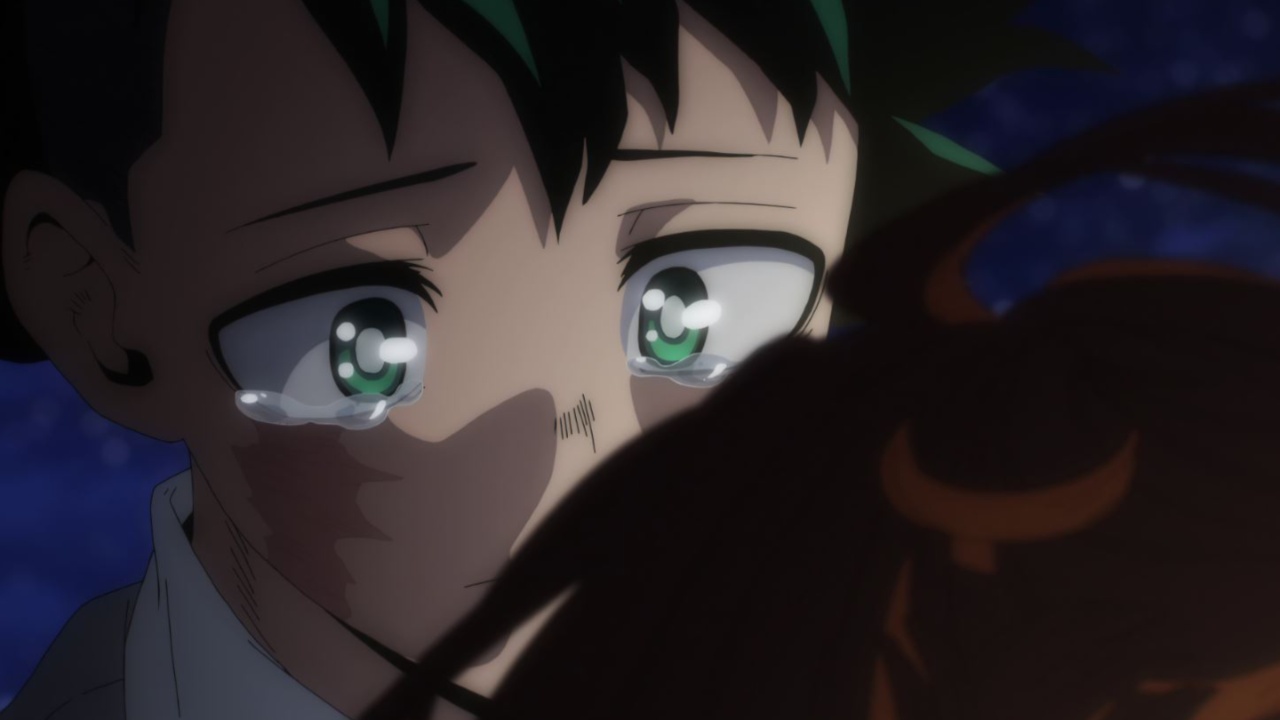
If the Spinner scene is the episode’s quiet storm, the climax is a thunderclap of feels on a familiar cliffside overlooking U.A. Ochaco Uraraka, still reeling from Himiko Toga’s sacrificial end, floats debris absentmindedly before crumbling under the weight of unspoken grief. Enter Deku, who pulls her into a hug that feels like the series’ emotional apex. Flashbacks to Toga’s blood-soaked smiles intercut with Uraraka’s sobs, her voice actress Ayane Sakura delivering a performance so visceral it could shatter quirk-enhanced eardrums. “She just wanted to be loved… to make people smile,” Uraraka chokes out, echoing the episode’s title.
But it’s Deku’s raw confession that elevates it to iconic: “You’re my hero, Ochaco.” In a full-circle moment from their pre-war pep talk on the same spot, he admits his fears—of failing her, of the quirkless future ahead—and she counters with fierce resolve. “We’ll carry it together,” she vows, their hands intertwined as the wind whips cherry petals around them. The animation here is Bones at their peak: fluid lines, dynamic camera angles, and a swelling OST that builds to a crescendo of hope. X exploded with Izuocha shippers in ecstasy—”WE WON IZUOCHA!” one post screamed, racking up thousands of likes—while others praised Sakura’s “Plus Ultra” vocals: “I cried buckets. What a performance.” Even skeptics melted, with reactions like, “A complete 180 from their last talk here. Gorgeous.”
Threads of Tomorrow: Class 2-A’s New Dawn
Weaving through the heaviness are glimpses of the future. Katsuki Bakugo, bandaged but unbroken, learns his arm may never fully recover—a “miracle” he’s alive at all, per the doctors. Yet, in true explosive fashion, he dives into rehab with a growl: “I’ll blow past this.” Hitoshi Shinsou officially joins Class 2-A, his brainwashing quirk now a tool for good, while Yuga Aoyama’s tearful exit hints at redemption abroad. These beats, rearranged from the manga for tighter pacing, underscore the theme of inherited legacies—heroes rising from the old guard’s shadows.
Fan Frenzy: Social Media’s Emotional Echo Chamber
As the credits rolled, X became a confetti storm of sobs and screams. Hashtags like #heroaca_a and #MyHeroAcademia trended worldwide, with over 670,000 views on the official post alone. “Buttery smooth animation and OST had me in awe,” one user raved, while another lamented, “Next week is the end? I’m not ready.” Ratings poured in at 8-9/10, praising the “gorgeous epilogue adaptation” and emotional highs, though some noted lingering pacing quirks. Even director Naomi Nakayama chimed in: “I’m already feeling the withdrawal… Let’s share this moving experience next week.”
One Last Smile Before the End
Episode 10 isn’t just a recap—it’s a love letter to every character who’s smiled through the pain, from Toga’s tragic grins to Uraraka’s tear-streaked resolve. In 11 episodes, Season 8 has compressed a manga’s worth of catharsis, but this penultimate outing feels like the series’ true heartbeat: Heroes aren’t defined by power, but by the smiles they fight to protect. As Deku gazes at the horizon, quirkless but unbroken, we’re left wondering—what does “My Hero Academia” mean when the credits finally roll?
Tune in December 13 for the finale, titled simply “My Hero Academia.” If today’s episode is any indication, it’ll be a send-off worthy of the Symbol of Peace himself. Until then, keep smiling, heroes. The world’s still counting on you.
ALSO READ: From Niche to Mainstream: The Rise of Anime as Global Pop Culture
Hello, I am Loubert and I am huge Bleach fan.
Well, I love anime in general and I enjoy researching and writing about the stuff I love.